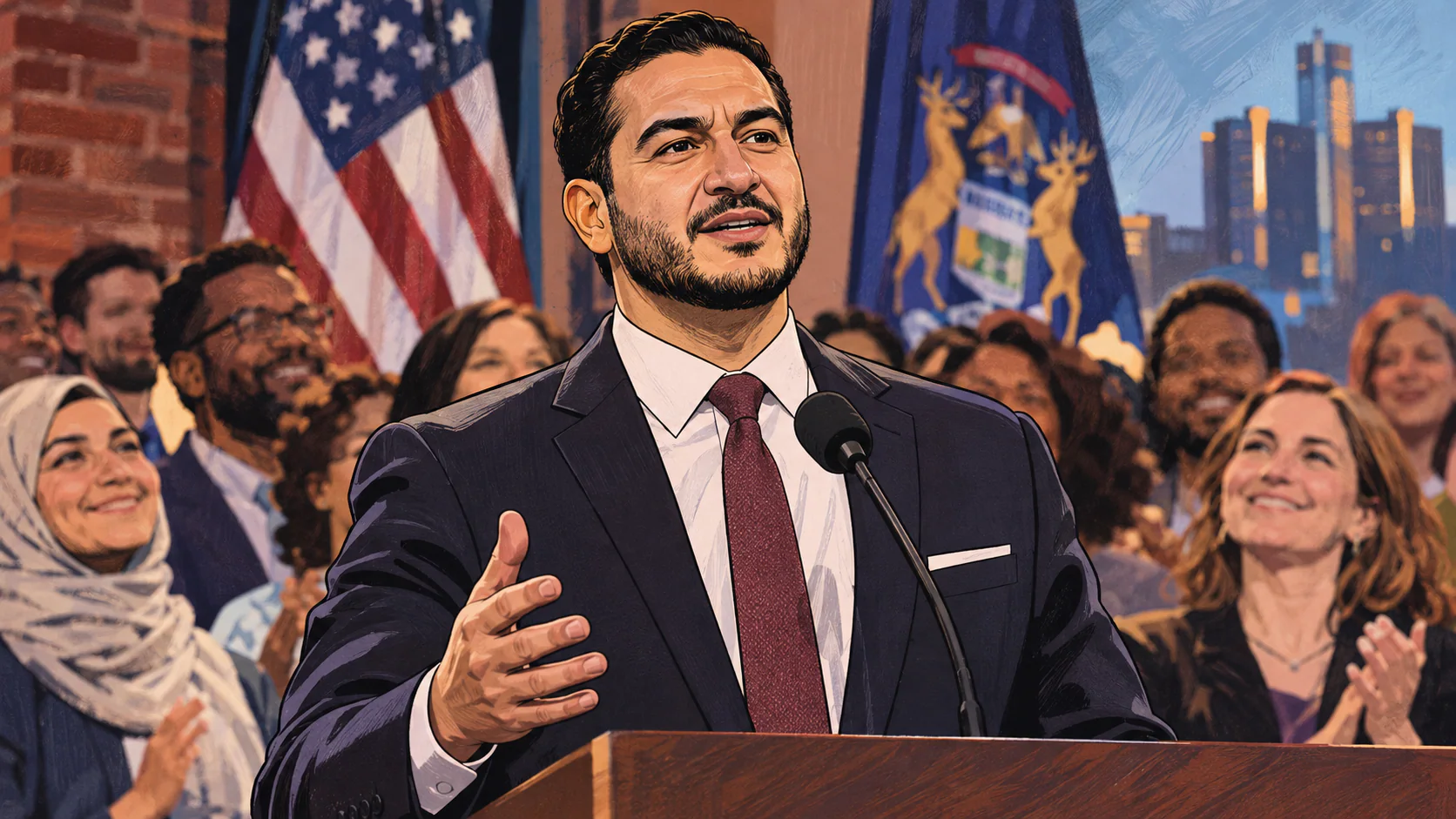
Abdul El-Sayed’s victory in Michigan’s U.S. Senate race is historic: he will become the first Muslim elected to the chamber. It is also a test of whether voters and commentators can separate identity, policy and political allegations rather than treating them as one argument. El-Sayed defeated Republican former congressman Mike Rogers on November 3, 2026, in the race for the seat being vacated by Democrat Gary Peters. He campaigned on universal health care, reducing corporate influence in elections and opposition to U.S. military aid to Israel.
For many Muslim Americans, the symbolism is substantial. Mohamed Gula, head of the advocacy group Emgage Action, told The Associated Press that he grew up after September 11 watching Muslim Americans treated as a security question. El-Sayed’s decision to introduce himself by his full name, Abdulrahman Mohamed El-Sayed, after his victory carried particular resonance for supporters who saw the moment as a rejection of that suspicion.
The physician and public-health specialist brings a record that predates electoral politics. He graduated from the University of Michigan in 2007 with degrees in biology and political science, later studied at Oxford as a Rhodes Scholar, earned a doctorate in public health and received his medical degree from Columbia. He taught epidemiology there before returning to Detroit in 2015, at age 30, to lead the city’s health department. He later headed Wayne County’s Department of Health, Human and Veterans Services.
A record shaped by public health
In Detroit, El-Sayed pushed for water testing in schools and early-childhood centers after elevated lead levels were detected. His department also expanded screening for lead exposure among children. Supporters cite that work as evidence of a governing style rooted in public-health intervention rather than campaign rhetoric.
His first statewide campaign ended in defeat. In the 2018 Democratic primary for governor, Gretchen Whitmer won 52.0 percent of the vote to El-Sayed’s 30.2 percent. His Senate victory eight years later marks a dramatic political reversal and gives the progressive wing of the Democratic Party a prominent national figure.
A three-minute Urdu commentary questioning why people celebrated El-Sayed focuses on abortion, same-sex marriage and LGBTQ+ rights. Those are legitimate policy questions, but the recording also blends verified facts with unsupported conclusions. In a June interview with Pride Source, El-Sayed said, “I intend to be a lion for rights.” He pointed to his work overseeing a Ryan White program for people living with HIV and collaborating with LGBT Detroit to train health department staff.
El-Sayed has publicly defended equal rights for same-sex couples, while the available interviews do not establish every specific marriage pledge attributed to him in the commentary. The legal question is separate from religious doctrine: in Obergefell v. Hodges, the Supreme Court held that states must license and recognize same-sex marriages. That ruling does not determine what a mosque or religious institution should solemnize.
Separating political allegations from evidence
The commentary’s allegation that George Soros spent 14 years preparing El-Sayed for political office is not supported by the evidence described. El-Sayed did receive a Paul & Daisy Soros Fellowship for New Americans in 2012 to support graduate education at Columbia. In September 2026, Jeffrey Soros, the founders’ son and George Soros’s nephew, hosted an El-Sayed fundraiser in California. Those facts show an educational connection and a later political relationship; they do not establish a long-term direction of El-Sayed’s career by George Soros.
The same distinction applies to abortion. El-Sayed’s platform supports federal legislation restoring protections previously recognized under Roe v. Wade, and Planned Parenthood Action Fund endorsed him on August 11, 2026. Islamic legal scholarship contains differing views on abortion, particularly early in pregnancy, while restrictions generally become stricter later. A fair description is that El-Sayed’s platform is more permissive than many traditional rulings, not that one religious position speaks for all Muslims.
The strongest conclusion is therefore straightforward: El-Sayed’s victory is historically important, but its meaning will depend on what he does in office. Voters can celebrate Muslim representation, question his positions on abortion and LGBTQ+ rights, and judge his health-care agenda independently.