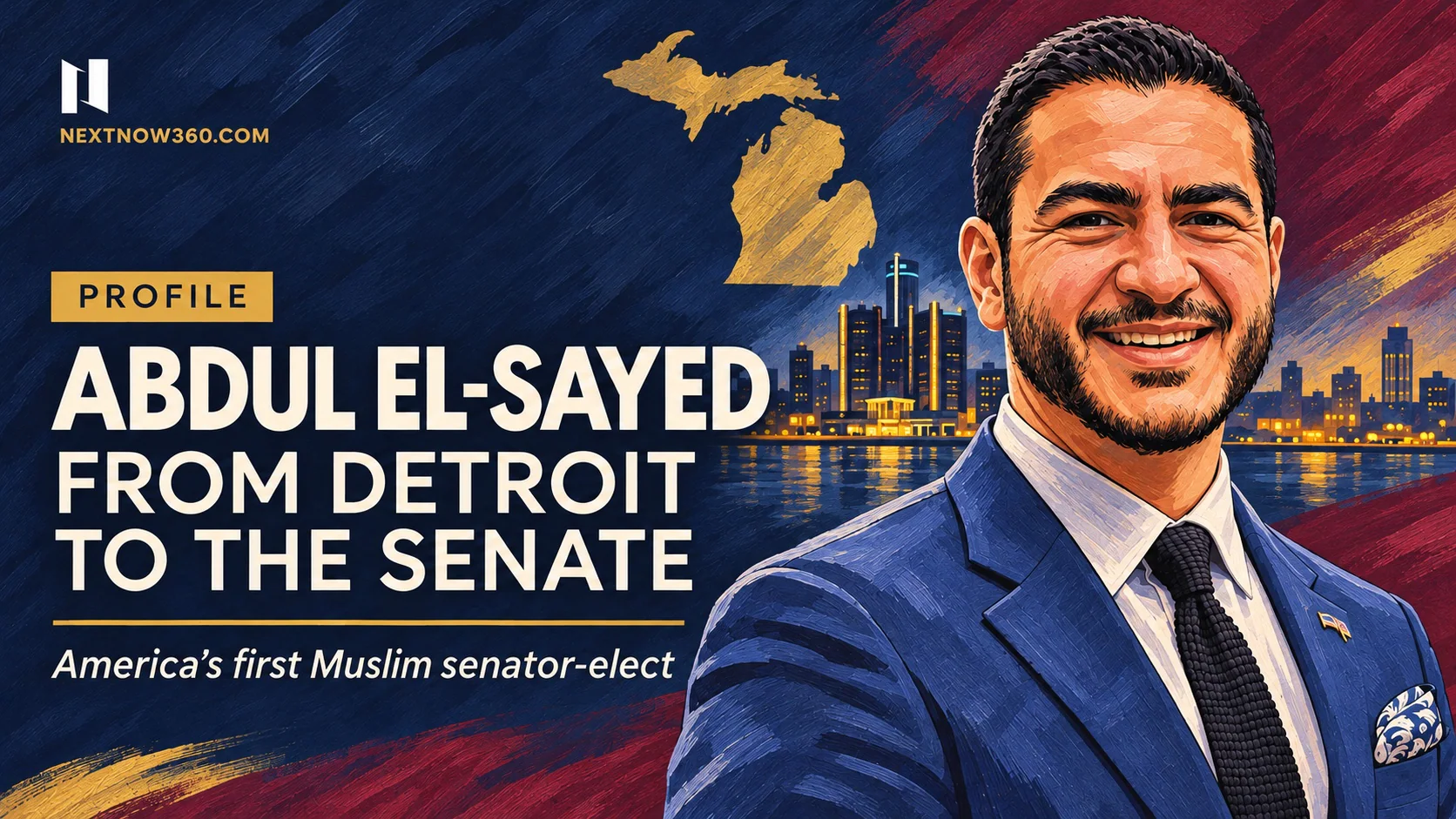
Abdul El-Sayed’s victory over Republican Mike Rogers in Michigan’s November 3, 2026, U.S. Senate election has made him the first Muslim elected to the chamber. He will remain senator-elect until taking office, but the result has already placed his political career in national history. The victory also completed a journey shaped less by Washington ambition than by questions about health, inequality and the influence of place on a person’s chances in life.
Born Abdulrahman Mohamed El-Sayed in Rochester Hills in 1984, he was raised in southeast Michigan. His father, Mohamed, came to the United States from Alexandria, Egypt, while his stepmother, Jackie, has deep Michigan roots. El-Sayed has spoken about the two family histories behind his identity: an Egyptian grandmother who raised eight children and an American grandmother, Judy, who served as a Presbyterian church deacon. He has said classmates shortened his first name to “Abdul” in kindergarten, a version he adopted without abandoning the name’s significance.
Summer visits to Alexandria gave El-Sayed an early view of how geography can shape health outcomes. He later described noticing a roughly 10-year difference in life expectancy between Egypt and the United States, then seeing a comparable divide within a short drive from his suburban home to Detroit. That experience helped direct him toward public health. At school, he captained football, wrestling and lacrosse teams. A Columbia alumni profile recounts an incident after the September 11 attacks, when an opponent’s insult about his Arab identity led El-Sayed to throw a punch. His coach’s warning—that he would carry his name for life—became part of his understanding of identity and public responsibility.
El-Sayed studied biology and political science at the University of Michigan, graduating with highest distinction in 2007, before earning a Rhodes Scholarship and pursuing doctoral work in public health at Oxford. He later received a medical degree from Columbia University. During residency training in New York, he recalled treating a woman in hospital and later seeing her sleeping on a subway. The encounter persuaded him that medicine alone could not repair the poverty, housing insecurity and other conditions that shape health before a patient reaches a clinic. He turned toward epidemiology and population-level prevention.
From Detroit health official to statewide candidate
In 2015, Detroit Mayor Mike Duggan appointed El-Sayed to lead the city’s health department as Detroit continued rebuilding after bankruptcy. His department worked on school water testing, children’s vision services, infant health, asthma and teen pregnancy. The city announced more than $1 million in grants for several initiatives in January 2017. The work also exposed the practical limits of public administration: a clinic relocation, for example, made appointments more difficult for some women without cars.
El-Sayed left the Detroit post in 2017 and ran unsuccessfully for governor in 2018, losing the Democratic primary to Gretchen Whitmer. He later wrote Healing Politics, co-authored Medicare for All: A Citizen’s Guide, hosted the America Dissected podcast and returned to local government. In Wayne County, he served as director of health, human and veterans services. One signature initiative, launched with Undue Medical Debt, aimed to eliminate up to $700 million in qualifying medical debt. A county report said about $56.5 million had been erased for more than 82,000 residents by January 2026; the $700 million figure was a potential program goal, not the amount already canceled.
Those experiences became the foundation of El-Sayed’s politics. He campaigned on Medicare for All, household affordability and limits on corporate political influence, while describing himself as a capitalist concerned about monopoly power. His criticism of U.S. military support for Israel and his responses to controversies involving Jewish communities made the campaign especially divisive. Republicans also raised unsupported allegations about extremist ties, which El-Sayed denied. Voters nevertheless chose him in a closely fought race that preserved the Democratic-held seat and delivered a breakthrough for the party’s progressive wing.
The next test will be practical rather than symbolic. El-Sayed has said winning a Senate seat is not itself the measure of success; the measure is what he can accomplish with it. His career has consistently returned to the same question: why do people living close to one another experience such different chances at a healthy life? In Washington, he will have to answer it through legislation, coalition-building and results.