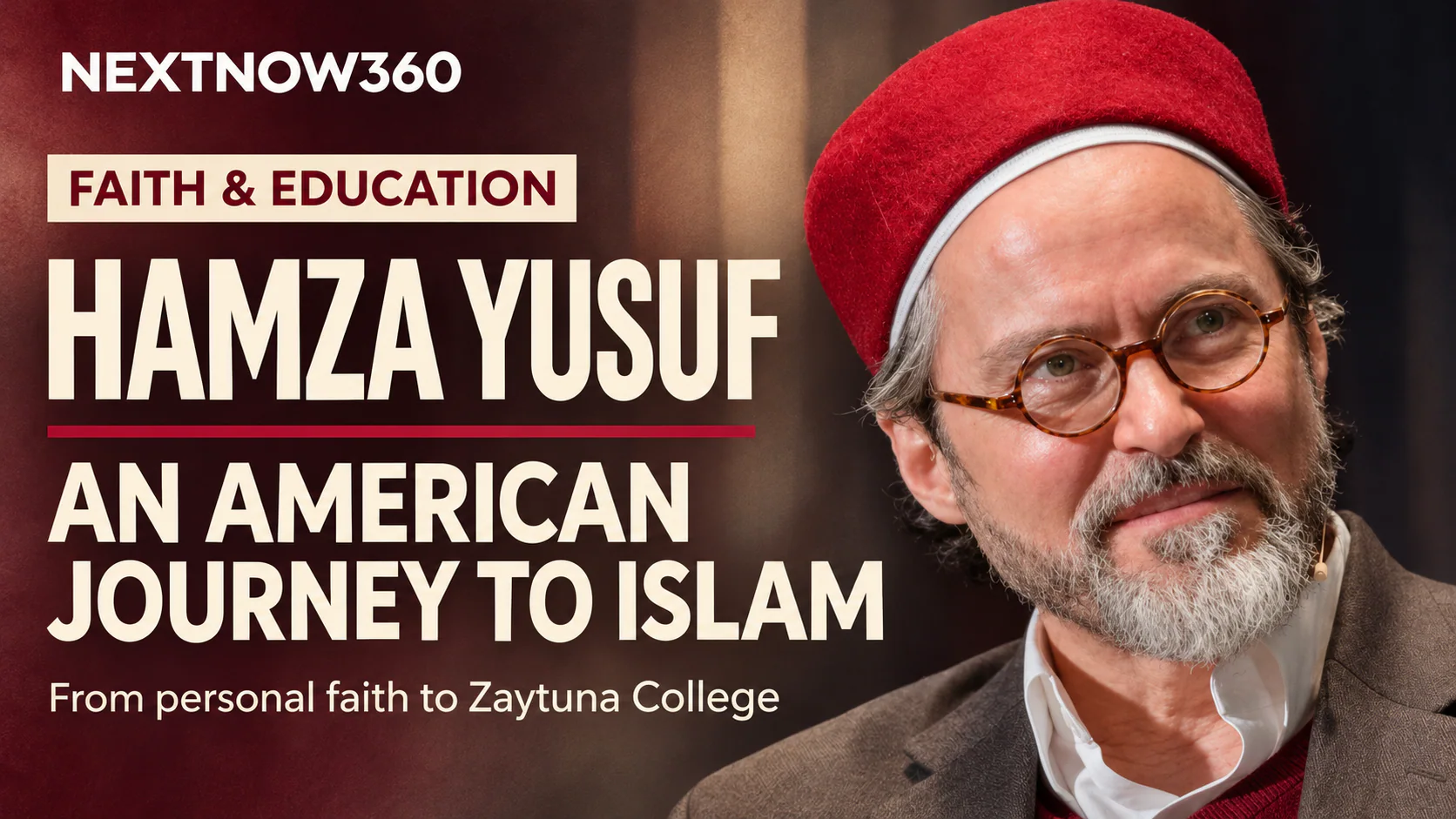
Hamza Yusuf’s journey from Mark Hanson to president of Zaytuna College spans religious inquiry, intensive Islamic study and the creation of a distinctive American institution of higher education.
Born in 1958 in Walla Walla, Washington, Yusuf was raised in Northern California in a Christian family. His father was Irish Catholic and his mother Greek Orthodox. In later accounts, he described an upbringing that encouraged religious questioning and opposition to prejudice.
A serious head-on car accident during his teenage years prompted a deeper examination of mortality, faith and the meaning of life. Yusuf embraced Islam in 1977, describing the decision as a continuation of the Abrahamic religious tradition in which he had been raised.
A decade of Islamic study
After his conversion, Yusuf pursued Islamic studies in England, the United Arab Emirates, Saudi Arabia and North and West Africa. His training included traditional instruction and teaching licenses in subjects including Qur’anic sciences, Arabic, Islamic law, theology, logic and ethics. His studies also took him to Mauritania, where he learned from scholars including Murabit al-Hajj. Zaytuna College lists his later academic qualifications as a bachelor’s degree in religious studies from San Jose State University and a PhD in Islamic studies from the Graduate Theological Union.
Yusuf returned to the United States determined to make traditional Islamic learning accessible to an English-speaking audience. In 1996, he helped establish the Zaytuna Institute, an educational organization that offered classes and lectures in the San Francisco Bay Area. Zaytuna’s institutional history identifies the institute as the foundation for the college that followed.
From institute to accredited college
Zaytuna College was established in Berkeley, California, and received accreditation from the Western Association of Schools and Colleges in 2015. The WASC Senior College and University Commission lists Zaytuna as an accredited institution and records 2015 as its first year of accreditation. Zaytuna describes the achievement as the first accreditation of an American Muslim college.
The college combines Islamic studies with the liberal arts, drawing on Muslim intellectual traditions and the classical traditions of Europe and North America. Its curriculum emphasizes disciplines such as grammar, logic and rhetoric, alongside Islamic texts and related fields. Zaytuna offers bachelor’s and master’s programs, including a master’s degree in Islamic Texts.
Yusuf remains president of Zaytuna College and teaches within its curriculum. The college credits him with books, translations, academic writing and work on Muslim ethics, spirituality and legal theory. His listed publications include Purification of the Heart and The Creed of Imam al-Tahawi.
The institution’s current accreditation status and Yusuf’s continuing role as president place the story beyond personal conversion: they show how his religious search developed into a permanent educational project in the United States.