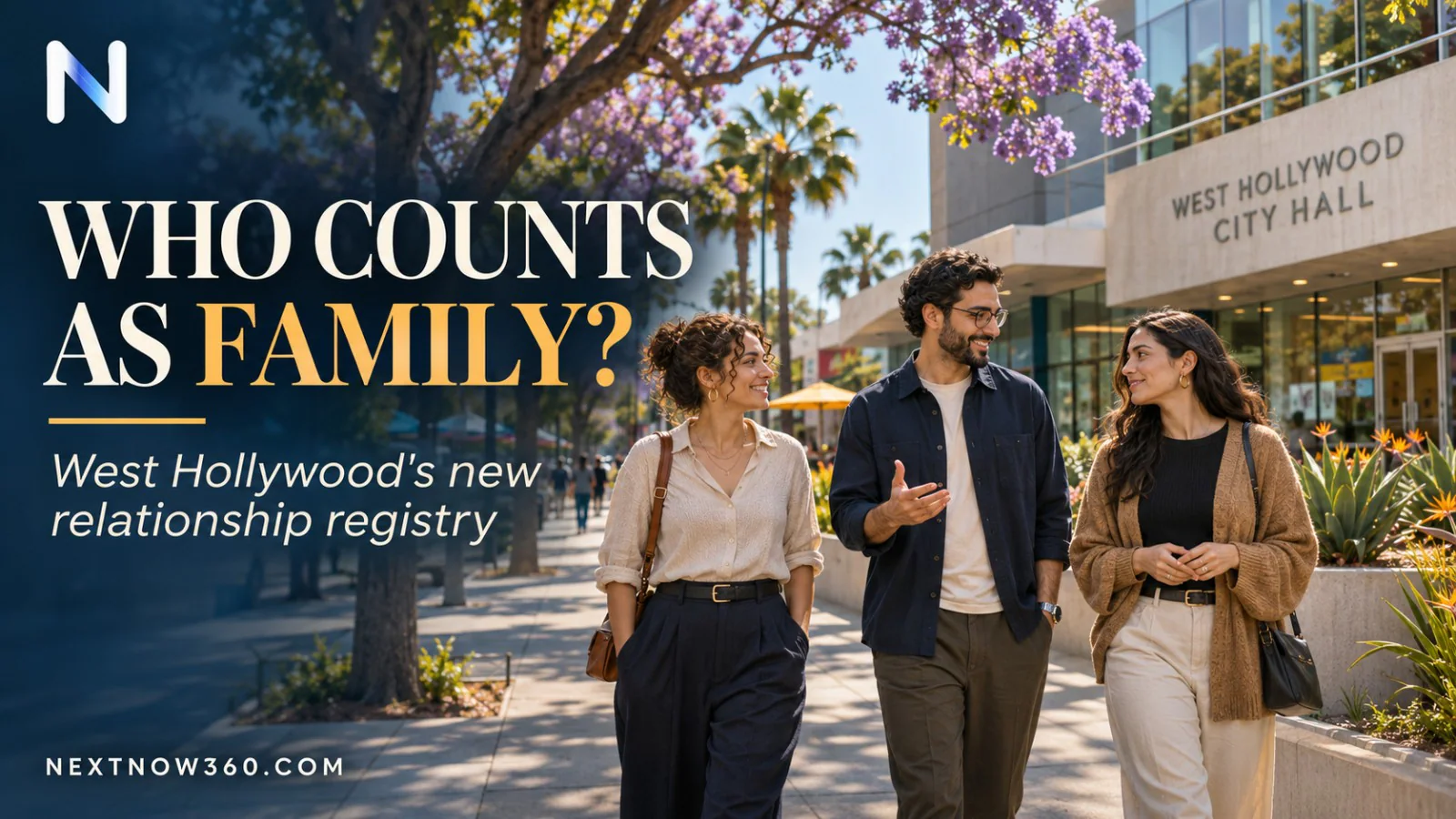
By UMAR JOHN | West Hollywood has approved a new registry for multi-partner domestic relationships, creating limited local recognition for families that do not fit the traditional two-person model. The City Council adopted Ordinance No. 26-13 on November 2, 2026. The measure defines multi-partner domestic relationships, establishes a registration process and extends selected protections involving health-care visitation, jail visitation and rental housing. It is scheduled to take effect on December 2, 2026.
The ordinance does not create a marriage, a California registered domestic partnership or a civil marriage for every person in the household. Its reach is also local. Registration in West Hollywood cannot automatically confer rights elsewhere in California, across the United States or in Canada. The practical issue is nevertheless significant: when a person becomes ill, is detained or faces housing insecurity, official recognition may determine whether a partner is treated as family or as a stranger.
Supporters frame the registry as a narrow administrative response to real households that already share care, finances and responsibility. That argument is strongest when it centers consent, transparency and equal treatment rather than romantic novelty. A registry can acknowledge a household’s commitments, but it cannot by itself prevent secrecy, coercion, unequal support or harm to children. Nor does the existence of a legal process prove that every relationship within its scope is healthy.
The Islamic question
The debate also requires precision about Islamic terminology. Polygyny—the marriage of one man to more than one woman—is not identical to the broader modern category of polyamory. Islamic discussions of polygyny traditionally emphasize permission within a framework of responsibility, financial support and justice, alongside the warning that a man who fears he cannot act fairly should marry only one. Any serious discussion must therefore address obligations, not only permission.
For some Muslims, a plural marriage may be understood as a sincere and freely chosen family arrangement. A widow or divorced woman should not be presumed unable to decide what companionship or commitment she wants. But consent must remain ongoing, and religious recognition does not automatically provide civil rights, inheritance protections, immigration status, hospital access or housing security.
Care is not a numbers game
Loneliness adds a wider human dimension, but it should not be used to promote one family structure as a cure. The World Health Organization defines loneliness as distress arising from a gap between the relationships a person has and those they want or need. It reports that roughly one in six people worldwide experiences loneliness and says the quality and supportiveness of relationships matter to health. (who.int)
Demographics do not establish a general need for plural marriage. The U.S. Census Bureau reports that women make up 50.9% of the U.S. population, while that national figure says little about any individual’s prospects, preferences or obligations. It cannot determine what any woman should accept.
There is no reliable national count of U.S. or Canadian Muslim families involving a second religious wife without a second civil marriage. Claims based on undocumented estimates should be treated cautiously. In Canada, the Criminal Code prohibits practising or entering into polygamy or a conjugal union with more than one person at the same time, whether or not the relationship is legally recognized as marriage. The offence can carry a maximum sentence of five years. (laws-lois.justice.gc.ca)
West Hollywood’s action is therefore limited but consequential: it recognizes certain relationships for specified municipal purposes without redefining marriage nationwide. The larger test is whether institutions can extend practical dignity and protection without abandoning consent, fairness and accountability. Those standards—not the number of people in a household—should remain the measure of care.